


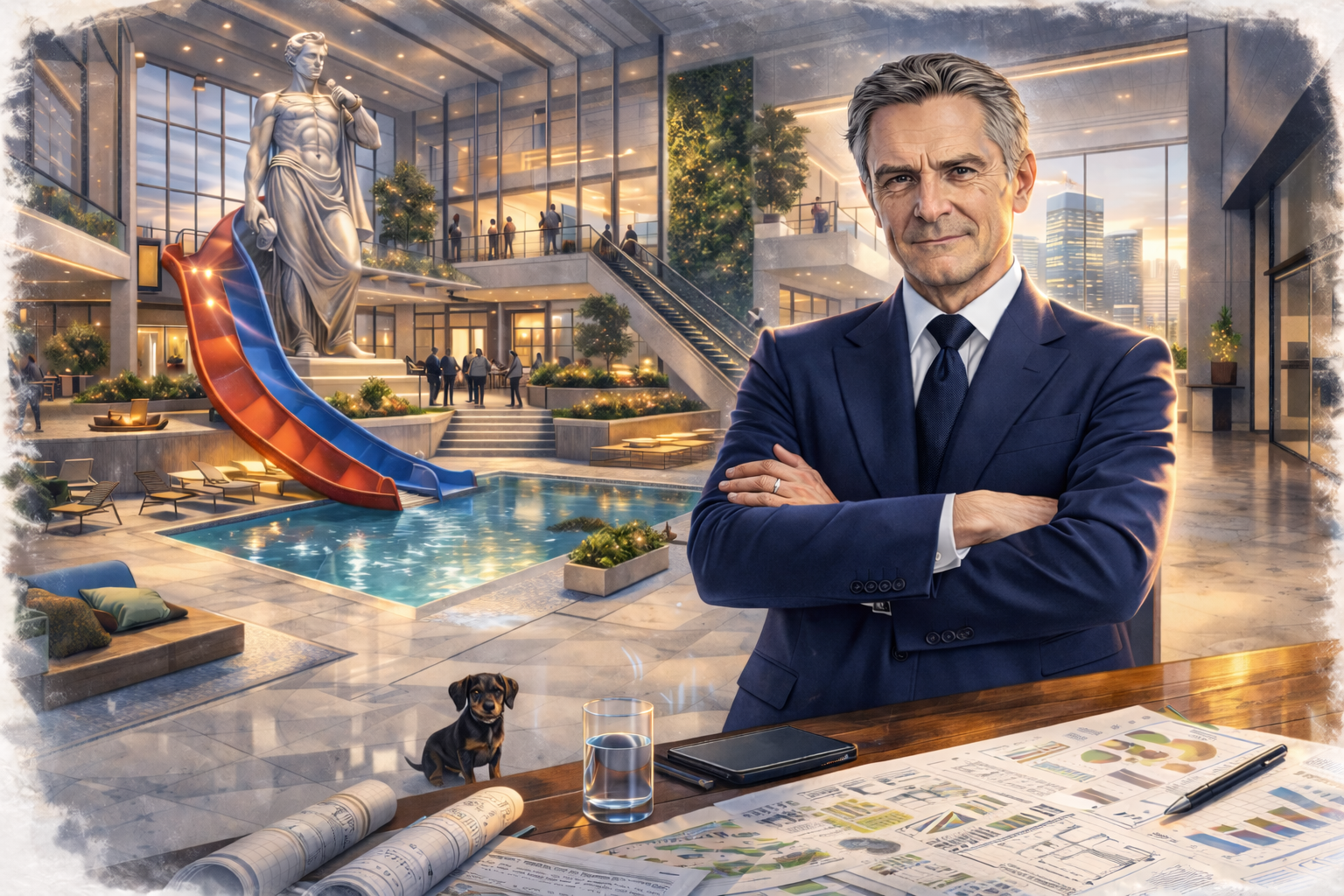
For years, the office was conceived as a tool for attraction.
Signature design. Experiential spaces. Integrated services. Immediate visual impact.
The logic seemed obvious: create a remarkable place to attract and retain talent. That logic is now reaching its limits.
Not because aesthetics have become secondary. But because real estate can no longer compensate for a blurred strategy or a misaligned culture through design alone.
The office does not create coherence. It reveals it.
What the new generations express most clearly is not a demand for spectacle.
It is a demand for alignment — and they cannot be blamed for that.
Alignment between discourse and practice has become a must-have. The same applies:
• Between employer branding and managerial reality.
• Between the promise of autonomy and actual decision-making power.
When alignment exists, space becomes an amplifier of collective performance.
When it does not, the building becomes an expensive backdrop — superficial at best, and at worst a signal of what is perceived as manipulation.
And the dissonance is immediately perceptible.
The era of the spectacle-office is ending. The era of the strategy-office begins.
Real Estate: A Governance Issue, Not a Decorative One
In too many organizations, real estate thinking comes after the fact.
Spaces are redesigned. Services are introduced. We speak of “employee experience” (let there be no confusion — this has nothing to do with the genuine search for experience in recruitment, which in reality — not theory — remains extremely rare).
But that is not today’s topic, and may deserve a future piece.
It is worth noting — and this is positive — that we are less obsessed with the word “experience” than we were in recent years, when it seemed to be used for everything: offices, cars, food, clothing…
I was almost waiting for the day the term would be widely used in the funeral industry. Because objectively, if there is one true experience — that certainly is one.
But enough digression. Let us return to the subject.
The real question comes before the architectural plan:
What corporate project do we want to embody physically?
A headquarters is not a show apartment — and certainly not makeup. It is the materialization of the company’s economic, managerial and cultural model, and of its true values.
Without a clear strategic vision, real estate investment becomes cosmetic. With a structured vision, it becomes a transformation tool.
The False Generational Debate
Opposing generations is comfortable. But strategically insufficient.
I have met — and continue to meet — young professionals who are far more motivated, engaged, enthusiastic, intelligent and even mature than many members of my own generation. Their greatest “flaw”? They place far more importance on authenticity than many of their elders, who are content to hide behind impeccably sanitized phrases.
For some, it is easier to take refuge behind a fantasized generational debate.
The so-called “new” expectations — purpose, progression, balance, recognition — concern all employees.
The difference lies in tolerance.
Younger professionals are less willing to accept the gap between promise and lived reality. Can we blame them?
And space makes that gap visible.
A collaborative environment does not compensate for vertical management. An integrated campus does not create internal mobility. A sustainable building does not replace a coherent ESG strategy.
Real estate does not disguise culture. It exposes it.
The Real Risk: Investing Without Clarifying
The question is not: “How do we make our offices more attractive?”
The strategic question is: “Does our real estate faithfully reflect our value creation model?”
Before investing, one must analyze:
• Decision-making maturity
• Responsibility structures
• Operational flows
• The real dynamics of engagement
Design comes after strategy. Always.
Otherwise, real estate investment raises expectations without guaranteeing delivery.
And in a competitive environment, the loss of credibility costs more than rent.
I created CARBYNE because I have always considered real estate one of the most structuring — and most under-managed — assets within an organization. This vision allows me to meet users and investors who, after multiple attempts in various directions, realize that this approach is the one employees truly expect — far removed from AI-generated studies filled with elegant analytical tables, weighted multi-criteria scoring models, or multi-layered heat maps.
Strategy. Human reality. Lived experience.
The office is not a space-planning issue. It is a governance issue.
Every square meter commits: capital, time, reputation,
and a promise made to teams.
Value creation — or destruction — does not lie in the quality of the furniture.
It lies in the quality of the strategic decisions that precede investment.
A building aligned with strategy strengthens managerial authority. A misaligned building weakens executive credibility.
Real estate is a silent revealer.
It exposes the strength — or fragility — of a corporate project.
In a world where talent analyzes as much as it observes, the only sustainable architecture is one that translates a clear, assumed and coherent vision.
The rest is aesthetics.
And aesthetics, without strategy, does not create value.